
Key Takeaways
- In 2024, there were 1,069 unintentional drug overdose deaths, a 18% decrease from 2023.
- From 2023 to 2024, overdose deaths decreased 27% among NH Black individuals.
- In 2024, 50% of overdose deaths involved both opioids and stimulants.
Illicit drug use continues to contribute to significant morbidity and mortality in Philadelphia. Since 2020, 6,281 people have fatally overdosed in Philadelphia. In 2022, there were 1,413 recorded overdose fatalities in Philadelphia; the highest number on record. In 2024, there were 1,069 overdose fatalities in Philadelphia, which is a 24% decrease from the all-time peak in 2022 and an 18% decrease from 2023.
The decrease in overdose deaths was not evenly distributed across all demographic groups. Steeper decreases in overdose mortality have been observed among Non-Hispanic (NH) Black individuals, in contrast to 2021-2023, when overdoses among NH Black individuals were increasing. From 2023 to 2024, overdose deaths among NH Black individuals have decreased by 27%. While trends in overdose mortality are decreasing, communities of color continue to be the most impacted. In 2024, 42% of overdose deaths occurred among NH Black individuals, and 15% occurred among Hispanic individuals. In addition, while overall overdose deaths are decreasing, the number of overdose deaths involving stimulants but no opioids (i.e., stimulant-only) increased by 8.6% from 2023 to 2024. Factors contributing to stimulant-only overdose deaths include heart disease, and PDPH launched a mass media campaign in November 2024 to increase public awareness of the association between heart disease and stimulant use.1
Polysubstance use also remains common among people who use drugs in Philadelphia. In 2024, although most deaths continued to involve opioids (n = 822, 77%), opioids and stimulants were co-detected in 50% (n=532) of overdose deaths. Other surveillance systems also highlight continued patterns of polysubstance use, including surveillance drug checking, which detected the introduction of medetomidine to Philadelphia’s dope supply in May 2024.3 In response, the Medical Examiner’s Office toxicology analysis was updated to test for medetomidine. From May through December 2024, medetomidine was detected in 18% of opioid overdose deaths.
While decreases in mortality are encouraging, trends in substance use morbidity remain high. The Philadelphia Department of Public Health (PDPH) continues to conduct surveillance of substance use-related outcomes in addition to overdose, such as emergency room presentations for drug withdrawal. There was an 89% increase in emergency room presentations for drug withdrawal from May 2024 to December 2024 after the introduction of medetomidine to the dope supply.2
Understanding evolving trends in overdose morbidity and mortality enhances the City’s ability to expand both clinical and community initiatives to reduce the harms of substance use.
Despite overall declining trends, from 2023 to 2024, there was an 8.6% increase in overdose deaths involving stimulants without opioids.
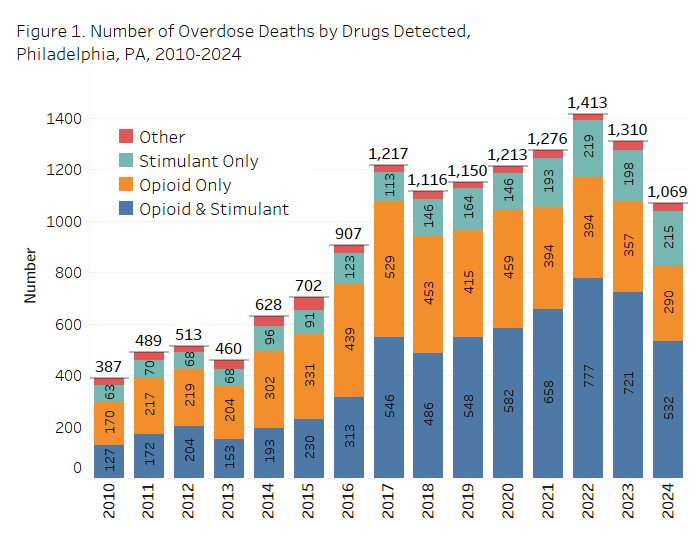
- In 2024, 1,069 individuals fatally overdosed in Philadelphia, an 18% decrease from 2023.
- Opioids were detected in 77% (n=822) of overdose deaths, a 24% decrease from 2023.
- Stimulants were detected in 70% (n=747) of overdose deaths, a 19% decrease from 2023.
- Many fatal overdoses continue to involve both opioids and stimulants, despite a 26% decrease from 2023.
- Opioids and stimulants were co-detected in 50% (n=532) of overdose deaths in 2024.
- 20% (n=215) of overdose deaths involved stimulants but no opioids, an 8.6% increase from 2023.
- 27% (n=290) of overdose deaths involved opioids but no stimulants, a 19% decrease from 2023.
Notable drugs and Adulterants (data not shown):
- Fentanyl and/or fentanyl analogs, an opioid, continued to be the drug most detected in overdose decedent toxicology in 2024. Fentanyl was detected in 93% (n=764) of opioid-involved overdose deaths.
- Cocaine was the second most common drug detected in overdose deaths in 2024. Cocaine was detected in 88% (n=660) of stimulant-involved overdose deaths.
- Xylazine, a veterinary anesthetic and analgesic commonly added to street opioids in Philadelphia, was detected in 34% (n=364) of all overdose deaths in 2024. 99% of overdose deaths that involved xylazine also involved fentanyl and/or fentanyl analogs.
- Medetomidine, a veterinary sedative like xylazine, was detected in Philadelphia’s drug supply in 2024. Philadelphia’s Medical Examiner’s Office began testing for medetomidine in May 2024 and detected medetomidine in 9% (n=92) of overdose deaths in 2024. 100% of overdose deaths that involved medetomidine also involved fentanyl and/or fentanyl analogs (data not shown).
From 2023 to 2024, overdose deaths decreased 27% among NH Black individuals, 26% among Hispanic individuals, and 4% among NH White individuals.
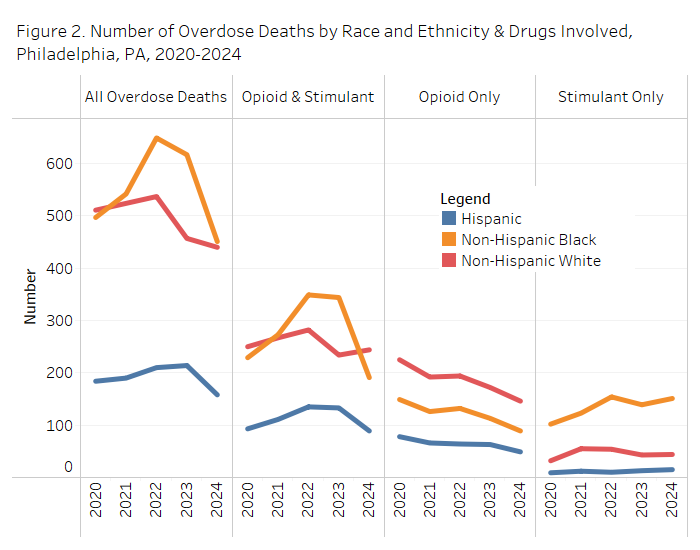
- There was an overall decrease in the number of overdose deaths from 2023 to 2024, but the rate of decline seen across race and ethnicity groups was not equal. In 2024:
- 42% of overdose deaths occurred among NH Black individuals, a 27% decrease from 2023.
- 41% occurred among NH White individuals, a 4% decrease from 2023.
- 15% occurred among Hispanic individuals, a 26% decrease from 2023.
- The number of opioid and stimulant-involved overdoses decreased 44% and 33% among NH Black and Hispanic individuals, respectively, but increased slightly (4%) among NH White individuals.
- Stimulant-only deaths increased among all race and ethnicity groups; the largest increases were seen among NH Black (9%) and Hispanic (15%) individuals from 2023 to 2024, compared to 2% among NH White individuals
- Stimulant-only deaths continue to disproportionately affect NH Black individuals. In 2024, 70% of individuals who died from a stimulant-only overdose were NH Black (data not shown).
Overdose deaths occurred throughout the city. In 2024, 59% of Philadelphia’s Zip Codes had 10 or more overdose deaths.
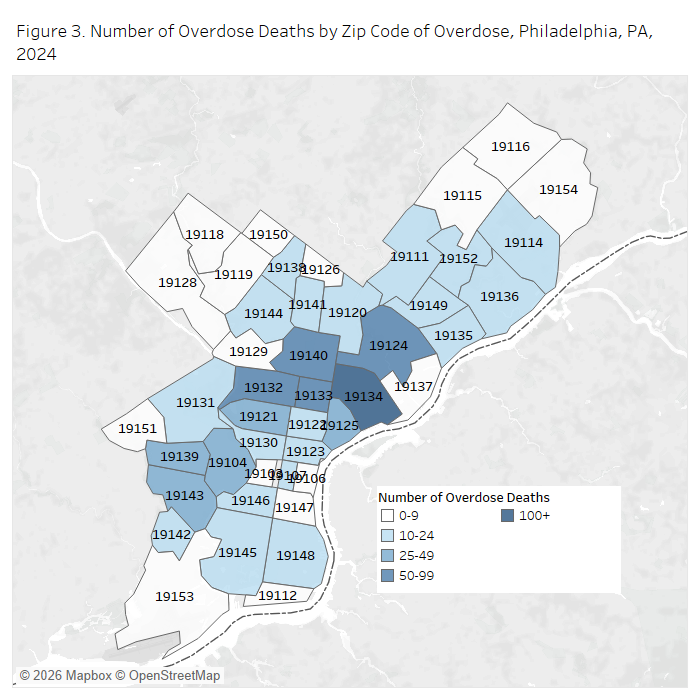
- Overdose deaths occurred in nearly every Zip Code in Philadelphia in 2024.
- The highest number of overdose deaths occurred in the 19134 Zip Code (n=179).
- Other Philadelphia Zip Codes with a high number of overdose fatalities in 2024 included 19124 (n=82), 19133 (n=58), 19132 (n=57), and 19140 (n=54).
What can be done?
The Health Department is:
- Addressing disproportionate rates of overdose in communities of color by:
- performing outreach and engagement in Non-Hispanic Black and Hispanic neighborhoods predominantly impacted by the increasing burden of fatal overdose,
- proactively engaging with and supporting populations who may not identify as people who use drugs or who may be reluctant to seek substance use services by providing education and resources to communities in neighborhoods where overdoses are highly prevalent,
- launching media campaigns and supporting city-wide initiatives to inform the public of the harms of substance use. The PDPH Heart to Heart campaign was launched November 3rd, 2024 to inform the public of harms related to stimulant use.
- Prioritizing harm reduction by:
- distributing naloxone, the opioid overdose reversal drug, as well as fentanyl, xylazine, and medetomidine test strips to individuals and community-based organizations. This includes by mail using NEXT Distro, at training and tabling events,
- updating overdose reversal training, shifting the focus to rescue breaths,
- providing trainings on harm reduction, opioid overdose recognition and reversal using naloxone,
- providing training on using fentanyl, xylazine, and medetomidine test strips,
- distributing wound care kits with a self-care guide to community organizations providing services for people who use drugs,
- offering free counseling and referrals to families with babies exposed to substances in utero,
- partnering with faith-based institutions, schools, and community groups to educate and provide resources to communities.
- Providing clinical health care providers with training, mentorship, and technical assistance on wound care, stimulant use, naloxone, withdrawal management, substance use treatment, and other substance use and harm reduction topics.
- Informing hospital-based clinicians of changes in the drug supply to inform and improve the care for people who use drugs in Philadelphia.
Health care providers should:
- Reduce stigma in their clinical setting by practicing with non-judgmental and non-stigmatizing language when talking about substance use with patients.
- Counsel all patients, even those without a substance use disorder, on naloxone and explain that it is available at pharmacies without a prescription or over the counter at major retailers, as well as from PDPH and local community-based organizations.
- Practice harm reduction treatment strategies like referring patients to substance use treatment providers, prescribing buprenorphine to opioid-dependent patients, and co-prescribing naloxone with opioids, buprenorphine, methadone, and extended-release naltrexone.
- Follow best practices for continuity of care for opioid use disorder in inpatient hospitalization settings and following hospital discharge. CareConnect can assist with bridge prescriptions and can be reached at (484) 278-1679.
- Stay up-to-date with the changing drug supply, including familiarizing themselves with medetomidine and medetomidine withdrawal.
- Recognize the importance of providing effective evidence-based withdrawal management with opioid agonist medications, such as buprenorphine and methadone.
- Use clinical tools and resources to help facilitate conversations with patients around stimulant use, including the health risks associated with using cocaine and other stimulants.
Philadelphians can:
- Visit https://www.substanceusephilly.com to obtain and get trained on how to use naloxone to prevent opioid overdose deaths. Free naloxone is also available at local fire stations. Naloxone is available at pharmacies in Pennsylvania without a prescription, as well as over the counter at major retailers.
- For those who use drugs, utilize universal precautions like carrying naloxone, starting with a small amount and going slowly, testing your drugs for fentanyl with fentanyl test strips, and using with others.
- If you don’t want to or can’t use with others, let someone know or call a hotline like Never Use Alone (English: 877-696-1996) or SafeSpot (800-972-0590).
- Avoid taking prescription medications that were not prescribed to you and/or were purchased on the street. If you do take them, use fentanyl test strips to test for fentanyl.
- Seek buprenorphine or methadone treatment if dependent on opioids.
- If you are unsure of what service you require and do not have medical insurance, please contact the Behavioral Health Special Initiative (BHSI) at 215-546-1200, Monday through Friday, between the hours of 8:30 a.m. and 5 p.m.
- If you want treatment for a substance use challenge and do not have medical assistance or Medicaid, please contact Community Behavioral Health (CBH) at 888-545-2600.
Technical notes
- The term “unintentional drug overdose” is defined as a death by overdose where the manner of death was not classified as intentional (suicide), undetermined, or a homicide. They are also referred to as “overdose deaths” or “overdose mortality.”
- Stimulants include cocaine, methamphetamine, and pharmaceutical amphetamines.
- Opioids include illicit fentanyl, heroin, and pharmaceutical opioids.
- Stimulant only refers to overdose deaths that had a positive toxicological test result for a stimulant and a negative test result for an opioid.
- Opioid only refers to overdose deaths that had a positive toxicological test result for an opioid and a negative test result for a stimulant.
- Opioid & Stimulant involved refers to overdose deaths that had a positive toxicological test result for both an opioid and a stimulant.
References
- Philadelphia Department of Public Health. It’s time for a Heart-To-Heart. https://www.substanceusephilly.com/heart
- Philadelphia Department of Public Health. Philadelphia’s Changing Drug Supply and Substance Use-Related Emergency Department Visits. CHART 2025;4(7):1-4.
- Philadelphia Department of Public Health, Drug Checking Findings: October-December 2025. https://www.substanceusephilly.com/q422025
Resources
For help on how to obtain and use naloxone, visit https://www.substanceusephilly.com/get-supplies/.
For information on how to access treatment, visit https://dbhids.org/addiction-services/
For harm reduction resources including syringe exchange, visit https://ppponline.org/
Suggested citation
Philadelphia Department of Public Health. Unintentional Drug Overdose Fatalities in Philadelphia, 2024. CHART 2026; 11(1):1-8.