Marconi Plaza in South Philadelphia is one of the city’s largest public open spaces. Broad Street divides the Plaza in half, creating two nearly identical spaces.
The City created the park in 1913. Famous landscape architects, the Olmstead Brothers, designed the park. In 1926 the park served as the gateway to the Sesquicentennial Exposition. This world’s fair, held in FDR Park, marked the 150th anniversary of the United States. At the time, most of the land south of Marconi Plaza was vacant. To connect the street grid with the fair, the City extended Broad Street south of Marconi. The park became the entrance to a grand, tree-lined boulevard that stretched to FDR Park.
Over time, Marconi Plaza has evolved into a mixed-use park. It features grassy areas, athletic fields, play areas, and shaded plazas. The park has received improvements, but community members sought other changes. They raised concerns about park safety and maintenance. To determine next steps, Philadelphia Parks & Recreation sought to create a plan.
Community engagement
The Marconi Plaza plan is the result of a community engagement process. Parks & Rec also hired a design team, Land Collective. They did extensive analysis of the site and how it functions.
A series of community workshops began in April 2022. At these workshops, park users & neighbors expressed their thoughts about the park. They also shared ideas about the park’s future. The workshops helped establish what the community liked about Marconi. It also helped determine needs and areas for improvement.
The Land Collective team used community feedback to determine design goals. With each session, the design became more refined and developed. The plan identified four key goals:
- Create a revitalized park.
- Improve accessibility.
- Create a civic core and active edge.
- Make it a welcoming place for all.
Proposed improvements
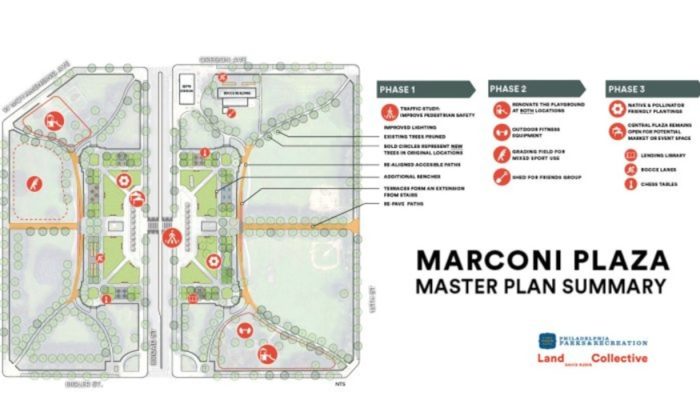
The plan created three phases of suggested improvements:
1) Upgrade critical infrastructure and park elements.
Improvements with the most impact will take place first. These include lighting and infrastructure repairs throughout the park.
- Improve site lighting.
- Prune existing trees & remove ones in poor or failing condition.
- Replace uneven hardscape & pathways
2) Enhance existing active and play spaces.
Activate and improve the spaces around the park’s edge. This is the “active perimeter.” It includes the sports fields and play areas.
- Renovate the playground at both locations.
- Install outdoor fitness equipment.
- Grade and reseed lawn for sport use.
- Add benches throughout park
3) Activate the elevated, middle plaza to serve as a civic space within the park.
The park’s under-utilized elevated middle section provides a unique opportunity. It can serve as a park within the park. The outer edge of this core could include passive play areas like chess or bocce.
- Add native and pollinator-friendly plantings.
- Plant new trees.
- Improve hardscape within the Central Plaza for potential events or vendors.
- Build a shed for Friends group.
- Install PPR signage.
- Install site furnishings & activities for social play such as:
- Chess tables.
- Bocce court.
- Lending library.
What’s next?
Philadelphia Parks & Recreation plan to start making these improvements a reality starting Spring 2026.