
by Morgan Fletcher, Community Resilience Assistant Coordinator, Philadelphia Office of Emergency Management | September 1, 2017
What is meteorology?
What is emergency management?
What are access and functional needs?
These are questions I seem to get on the regular whenever asked about my background. Usually people would get tired of repeating countless times what it is they do for a living; admittedly, I once fell into this group. However, it occurred to me that maybe these are the exact questions I should be getting.
Not only do I get to reflect on my diverse background as someone who’s just starting out in the professional world, but I get to educate others in the process. I have the unique ability to be a translator, helping people realize the many threats to their safety that are out there and what it is they can do to personally prepare. Simply having these conversations and opportunities to educate and motivate others reminded me that I too am still learning with each passing day.
Just a few months ago, I had the same lingering question, “What exactly is AFN?”
Initially I was under the skewed impression that disabilities are simply physical limitations, but that was the extent of my knowledge related to AFN. It wasn’t until interning with the OEM that I was exposed to people who’ve dedicated their entire careers to advocating for those with access and functional needs. I thought to myself, “Maybe this is something I can do to broaden my horizons.” I took a risk and went out for a full-time position at the OEM as an advocate for AFN inclusion through the AmeriCorps VISTA program, and here I am a few weeks into my service year. Before starting my position, I was a bit apprehensive. I had only attended a few trainings related to AFN and spoke occasionally with the former VISTA in my position, who I’d consider a subject-matter expert.
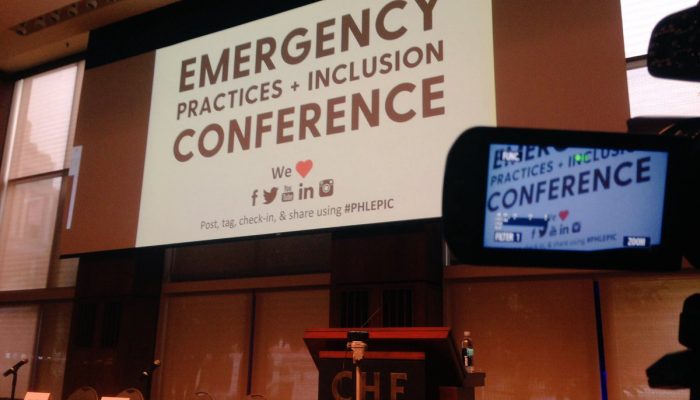
Here I am going into this position with only a broad knowledge of the emergency management field, and I have some big shoes to fill. How am I going to do this? Well I knew I’d have to do whatever possible to increase my knowledge on the topic and that meant A LOT of research. Of course this was a great way to delve into the technical side of things, but something was missing, the human side. It’s one thing to read some information on a page in front of you, but it’s another to hear it from someone with a real passion and connection to the topic. Scrolling aimlessly on Twitter one night, I saw the OEM advertising for the Emergency Practices and Inclusion Conference aka EPIC; the timing was perfect. I signed up immediately, but once the day of the conference arrived, I was unfortunately ill. However, because of the ever so prepared OEM, I was able to attend the conference virtually. It may not have been the same exact experience as physically attending, but it had an incredible impact and opened my mind to so many facets that I never considered.
Each speaker was unique in his or her own right, yet presented topics that were equally relevant in the realm of AFN inclusion in emergency management. From legal matters, to accessible design, from children, to food access, the topics varied but highlighted the diversity under the umbrella of access and functional needs. Interestingly enough the speakers barely scratched the surface in their respective areas.
There’s such a wealth of information on AFN topics that conferences like these could go on for days. However, the great part about having such a variety of topics wrapped into such a short amount of time is that attendees are able to relate to different parts where their interests lie. There was a piece of something for everyone and even the opportunity to explore a subject area that was unfamiliar, raising both curiosity and awareness.
One topic that really resonated with me was “accommodation” versus “inclusion”, presented by the final speaker Neil McDevitt, ironically known as “The Closer”. Using two video examples, Neil elaborated on the importance of working with the access and functional needs community to better understand inclusion practices, rather than simply treating community members as a “problem” to be solved. There should be equal opportunity for jobs for those with access and functional needs, not just positions focused on disabilities, but on all levels. Community members are integral in implementing such solutions to make emergency preparedness more inclusive, and Neil poignantly stressed this point.
Ultimately, EPIC was a great experience, cohesively organized, diverse in topics and speakers, and the perfect way to kick off my VISTA year. It was not only a learning opportunity, but a reminder for me to go into this year of service with an open mind. OEM Director Dan Bradley keenly stated in his opening remarks, “AFN inclusion is a continuous commitment and something that requires strengthening partnerships and working together to better serve the whole community.” It is not solely up to responders or even those within access and functional needs community groups. It’s about collaboration, learning from each other, and having these conversations to make emergency preparedness inclusive for all.
Visit our Facebook page and search #PHLepic to view livestream videos from the conference.