
Calls for new, recurring revenue to protect school-based jobs and sustain student progress
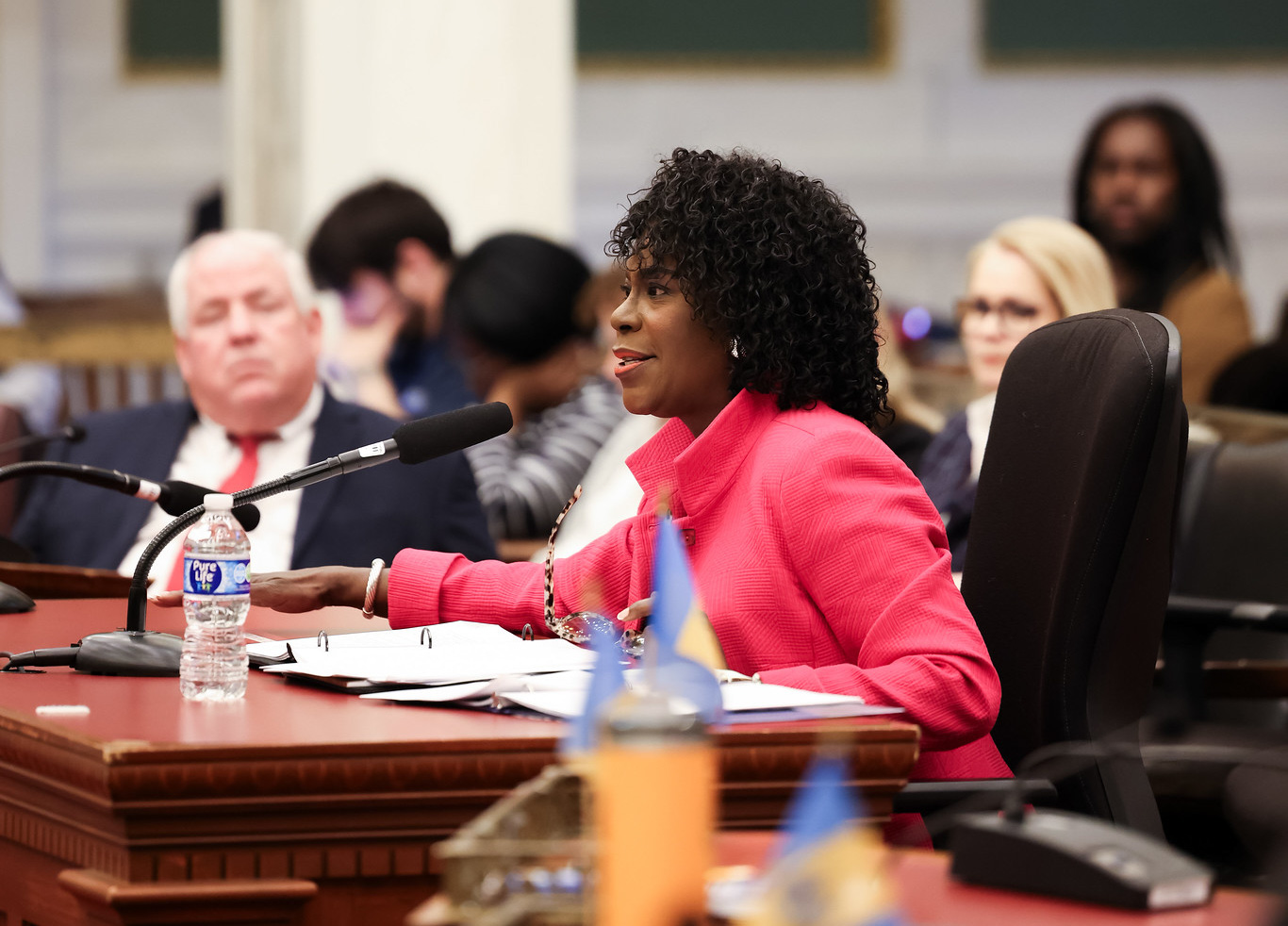
PHILADELPHIA — Mayor Cherelle L. Parker today addressed City Council’s Committee of the Whole on the state of the School District of Philadelphia and the need for new funding during the Biannual Education hearing in Council.
See below for Mayor Parker’s remarks as prepared for delivery:
Good morning.
Council President Johnson, Majority Leader Gilmore Richardson, Majority Whip and Education Committee Chair Thomas, and all Members of Council—thank you for the opportunity to be here today to speak about a topic that is critically important to me and I know to all of you: the 198,000 students educated in our District and charter schools.
Councilmembers, I want to thank you, and historically City Council, for always standing up for public education and our students—and I don’t expect this year will be any different.
I want to acknowledge Board President Reginald Streater, Vice President Sarah Ashley-Andrews, and all the members of the Board of Education. Thank you for your dedicated service to Philadelphia students and your stewardship of this District.
To Superintendent Tony Watlington and your outstanding leadership team, thank you.
Dr. Watlington, you came here and set an ambitious goal to make Philadelphia the fastest improving large urban district in the country—and you and your team are getting it done.
Finally, I want to acknowledge the members of our extended education community who are advocating every day to ensure that our students have what they need to learn and grow: Arthur Steinberg from the PFT, Dr. Robin Cooper from CASA, Nicole Hunt from Unite Here, Bernadette Ambrose-Smith of the School Police, the principals, teachers, all our advocacy partners, parents, and community members who care about Philadelphia public schools.
Here, Bernadette Ambrose-Smith of the School Police, the principals, teachers, all our advocacy partners, parents, and community members who care about Philadelphia public schools.
I am incredibly proud of the progress that our District schools are making.
Student attendance, test scores, and graduation rates are increasing, while dropout rates are decreasing.
Our Extended Day, Extended Year program is delivering real results for Philadelphia families. That is economic mobility!
Ninety-seven percent of parents report they are satisfied with before- and after-school programming, during the school year and winter, spring and summer breaks —that reflects real trust.
Just as important, 95 percent say this free programming allows them to focus on work, and 92 percent say it’s helping them save money.
EDEY programming helps students build strong connections to their schools. This year, students who attended EDEY programs just one day a week had a 78 percent attendance rate, and those who came four days a week had an attendance rate of 82 percent—higher than the district average for all elementary schools.
And let me say one more thing about this program: our children deserve the same kinds of educational enrichment programs that kids in the suburbs get—that is the path to self-sufficiency, and I’m unapologetic about it.
We’re also strengthening academics, piloting programs in 10 schools with Joyful Readers, Kumon, and Springboard Collaborative.
And we’re expanding enrichment, including field trips to the Marian Anderson Museum, the Arden Theater, and the Spirit of Philadelphia.
And through the One Philly Produce Project, we’ve distributed more than 38,000 pounds of food to families—because supporting learning means supporting the whole child.
I am pleased that my administration, the School District, the Board, and this City Council are aligned in our commitment to public education and student success.
But, Mr. President, Chairman Thomas, we cannot rest. We are facing headwinds that threaten to stop the progress.
This reminds me of approximately 12 years ago, when the School District of Philadelphia was facing a financial crisis due to circumstances beyond its control—the loss of state and federal funding.
As leader of the Philadelphia House delegation, with the Council President, Darrell Clarke, I fought for the sales tax increase of $120 million and the cigarette tax increase of $83 million—money the District needed just to keep the doors open. Senator Williams offered the cigarette tax in the Senate; I offered it in the House.
And I am proud of what we did then to stabilize the District with new recurring revenue.
I had hoped that was enough and that we would never be in that place again.
The very same year we secured the cigarette and sales tax revenue, the lawyers at the Education Law Center and Public Interest Law Center filed a lawsuit claiming that the state’s system of education funding was unconstitutional.
Nine years later, the Commonwealth Court agreed, and the General Assembly told Philadelphia that we were underfunded by $1.25 billion every year.
Thanks to Governor Shapiro and the Philadelphia delegation, the Commonwealth has begun paying off the debt that it owed Philadelphia students.
We are grateful—Governor Shapiro, Speaker McClinton, Appropriations Chairs Harris and Hughes.
And this Council has always stood up!
But the years of chronic underfunding have just caught up with us.
The federal COVID funding that came to the School District during the pandemic provided temporary relief, but that funding is now gone.
The District has cut central office staff and reviewed and cut contracts too.
We are now facing another critical tipping point. The School District is facing a $300 million structural deficit.
As a result of the loss of federal funding, the School District is forced to consider cutting 340 school-based positions.
These cuts would have an enormous impact: 149 teachers, 23 counselors, 119 climate staff, plus other administrative and support staff. Two hundred six schools would be impacted.
In schools across this city—from North Philadelphia to West Philadelphia to the Northeast—students will feel the loss of trusted adults in their lives. The impact will be felt in every Council District.
Let me be clear what that would mean:
Larger class sizes, less academic and social support for students, and less stability in schools that are beginning to make progress.
That is unacceptable to me, and I know it is equally unacceptable to you.
On March 12, I submitted my proposed FY2027 One Philly, One Future budget to City Council for its consideration.
That evening, we first learned that the School District was planning to eliminate 340 school-based positions to deal with a $300 million structural deficit.
That was totally unacceptable to me, and so I announced a short time later that I was proposing a $1 tax on rideshare rides originating in Philadelphia to raise $48 million a year to help the School District step back from 240 of those 340 school-based positions being eliminated.
That still wasn’t enough. I listened to school union leaders and education advocates—people like Arthur Steinberg at the PFT, Dr. Robin Cooper at CASA, our School Police union leadership, and Unite Here, as well as Donna Cooper at Children First and Dan Urvick Acklesberg at the Public Interest Law Center—and I knew we had to do more.
We went back to the drawing board with School District leaders and said, “Bring us a plan with zero school-based job cuts if we get the District $50.4 million in annual, recurring revenue.” And that is what they did.
This week, my administration submitted proposed amendments to establish a $1 rideshare tax. This measure, combined with an adjustment to the Use and Occupancy tax on cell phone towers, will generate approximately $50.4 million in recurring revenue for the School District.
And if we don’t approve these measures, students’ academic progress will be jeopardized: larger class sizes, less support for students, and less stability in schools.
That is not acceptable.
There has been a great deal of discussion and, quite honestly, misinformation about this rideshare tax, and I want to share some facts with you.
Rideshare taxes are common. Fifty-one states and localities have passed rideshare taxes.
Washington, D.C. has a rideshare tax. Chicago has one, and so does New York.
San Francisco—where Uber and Lyft are headquartered—has had a rideshare tax since 2020.
Baltimore has a local rideshare tax.
If you are concerned that this tax will rest on the shoulders of low-income families, let’s look at the facts.
According to U.S. Census data on Philadelphians’ travel patterns, only one percent of Philadelphians earning under $50,000 use rideshare or taxicab services to get to work on a daily basis.
State preemption law requires our legislation to technically impose the tax on consumers, but these tech companies can afford to absorb this one-dollar increase.
Don’t take my word or the U.S. Census Bureau’s. New York labor economist James Parrott, from the New School, submitted testimony to Council stating that it does not seem too much to ask these giant tech companies to absorb the proposed $1 per-trip tax rather than further enrich their shareholders or pass on the tax to their Philadelphia passengers.
It’s a choice for these multi-billion-dollar companies.
So I am asking you to work with me and take this small, responsible step to keep Philadelphia students on the path to success and better futures.
Before I leave, I must discuss the other major issue facing our District that I know is on everyone’s mind in this room.
Another casualty of decades of underfunding is school district facilities.
I am a product of Philadelphia public schools, and I love every school I attended—Rowen Elementary, Austin Meehan Middle School, Parkway Program High School.
But the simple fact is that to renovate or repair every public school will cost $7 billion, and that is just not feasible.
Philadelphia’s school facilities are, on average, more than 70 years old. They lack the modern equipment and layout needed to educate students in the 21st century.
Many are operating far below capacity, with thousands of empty seats across the system. Others are severely overcrowded.
At the same time, students are learning in buildings that are outdated and not designed for the opportunities we say we want for them.
And we have to ask:
Are we building a system for the past—or for our children’s future?
Because right now, we are maintaining square footage as it crumbles instead of investing in the opportunities our students actually need.
This means making difficult but responsible decisions, and that’s what the District has proposed with its facilities plan.
Rightsizing buildings is not about abandoning communities. It is about strengthening them.
Let me be clear: the school facilities plan is not about the value of the buildings. It is about giving students more resources and more opportunities in better buildings than the ones that will close.
The impact on students will be real and tangible.
All middle school students will have access to Algebra I instead of slightly over half.
More students will have access to art, music, and physical education.
The share of schools offering five or more AP classes will grow from 38 percent to 50 percent.
How many times as members of this body have we asked why are magnets getting more advanced curriculums compared to other schools?
The share of incoming kindergarteners with access to pre-K will double, from 25 percent to 50 percent.
We must be willing to make decisions that are uncomfortable in the short term because they are necessary for our children in the long term.
I think about the students I meet in our schools. They are not asking for perfection. They are asking for a fair shot.
So today, I am respectfully asking this Council, as partners who have always stood with our students, to continue moving forward.
Because years from now, our children will not remember the debates.
They will not remember the multi-billion-dollar tech companies.
But they will live with the consequences of the system we choose to build.
And above all, let us continue to choose our children, as you all have repeatedly done.
Thank you.