
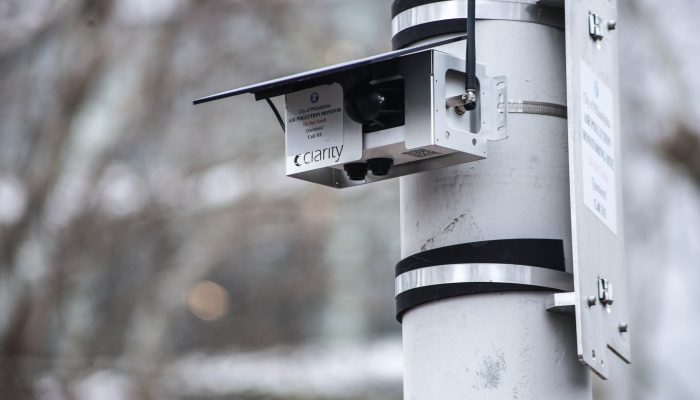
Breathe Philly, the Health Department’s new air monitoring project, increases Philadelphia’s air monitoring capabilities and improves community access to air quality data. With over 75 sensors placed throughout Philadelphia, we are able to measure two common air pollutants, particulate matter (PM2.5) and nitrogen dioxide (NO2). These sensors measure pollution in real-time so you can see current air quality where you live, work, or play using the Breathe Philly dashboard.
Why measure air quality?
Air quality is important to our health, and to the health of our environment. Some air pollutants can impact many different parts of the body over time, including the heart and lungs. Air pollution may also cause or contribute to asthma. Air pollution comes from many sources, including industry, power generation, home heating or cooking, and cars, trucks and other vehicles. People with pre-existing health conditions like asthma may be more affected by poor air quality.
How we monitor and improve air quality
The Health Department’s Air Management Services division issues air permits, enforces regulations, monitors air quality and reports results to the public. The Health Department has 10 regulatory monitoring stations throughout the city and runs other innovative air monitoring projects. Those projects include the Village Green air monitor, which you can see at 6th and Arch Streets, and a new collaboration with NASA that monitors air quality using satellites.
The new Breathe Philly tool adds dozens of sensors to the existing network allowing us to research air pollution in more specific areas and create regulations to make air cleaner. If Breathe Philly shows one sensor or neighborhood has unusual air pollution, the Health Department will investigate using our Mobile Monitoring System.
Finding and using air quality information
With the Breathe Philly dashboard, you can now find data from more than 75 Breathe Philly sensors, and through the 10 existing monitoring stations. In addition to the real-time sensor network, the dashboard will display information about common air pollutants, show trends in air pollution over time, and provide easy access to historic data and air quality reports. This dashboard will be a one-stop-shop for air quality information and data that all residents can use – for research, education, or personal decision-making.
Stay informed and protect your health
In Philadelphia, poor air quality days are rare, but when they do occur, Breathe Philly can help you stay informed and protect your health. You can view air quality alerts and recommendations directly on the Breathe Philly dashboard, from your computer or your mobile device. For example, on some poor air quality days, you may be advised to shorten or avoid outdoor exercise. You can even sign up for an email alert for the sensor nearest to you, so you can stay aware of any changes in air quality.